Monday, 20 August 2018

The letter to "the People of God" calls for an end to the "culture of death" in the Church, addresses failures to deal with abuse and asks for forgiveness.
Last week a grand jury report detailed seven decades of abuse in Pennsylvania.
The landmark investigation found more than 1,000 identifiable minors had been abused by 300 priests in the US state.
Thousands more are thought to have fallen victim. The inquiry found evidence of systematic cover-ups by the Church, with many cases now too old for prosecution.
After the report was made public, the Vatican said the Pope was on the side of victims against "predator" priests.

What did the Pope say?

The Vatican says it is the first time a Pope has addressed a letter to the entire Catholic population on the topic of sex abuse.
In Monday's 2,000-word letter he addresses the US scandal directly and acknowledges the Church's role in failing to act sooner.
He describes the "heart-wrenching pain of these victims" that were "long ignored, kept quiet or silenced".
  • Read the letter in full
  • Sex abuse and the Catholic Church explained
  • US cardinal resigns over abuse claims
"With shame and repentance, we acknowledge as an ecclesial community that we were not where we should have been, that we did not act in a timely manner, realizing the magnitude and the gravity of the damage done to so many lives," he writes.
"We showed no care for the little ones; we abandoned them."
The Pope's message quotes a passage from the Bible in Corinthians that says "if one member suffers, all suffer together" and calls for the Church to come to grips with the reality of what has happened in a "comprehensive and communal way".
"If, in the past, the response was one of omission, today we want solidarity, in the deepest and most challenging sense, to become our way of forging present and future history.
"It is essential that we, as a Church, be able to acknowledge and condemn, with sorrow and shame, the atrocities perpetrated by consecrated persons, clerics, and all those entrusted with the mission of watching over and caring for those most vulnerable. Let us beg forgiveness for our own sins and the sins of others."

What are the latest cases?

The letter's release comes days before the Pope is due to travel to Ireland to address the Church's World Meeting of Families.
The head of Ireland's Roman Catholic Church, Archbishop Eamon Martin, has said he expects Pope Francis to meet victims of clerical sex abuse during his visit to Dublin.
Child sexual abuse scandals continue to embroil the Church around the globe.
Last month the former archbishop of Washington DC, Theodore McCarrick, stepped down over abuse accusations against him.
US church officials described as credible allegations that he sexually assaulted a teenager nearly 50 years ago. He says he has no recollection of this.
In May, Archbishop Philip Wilson became the most senior Catholic in the world to be charged with concealing child sexual abuse in Australia in the 1970s.

What has the reaction been?

Margaret McGuckin from Survivors & Victims of Institutional Abuse, a historic abuse charity based in Northern Ireland, said the Pope's response was "too little too late" and said "nothing will change" with the letter.
Anne Barrett-Doyle, co-director of clerical abuse tracking website BishopAccountability.org, said there needed to be "more actions, less words" from Pope Francis.
"He needs an effective discipline process for bishops and religious superiors who are known to have enabled abuse," she said.
Irish campaigner Marie Collins, who was abused by a priest as a teenager, welcomed the condemnation of Church cover-ups, but said more concrete action on accountability was needed.
Skip Twitter post by @marielco
Last year Ms Collins resigned from a Vatican child protection commission set up by Pope Francis because of what she said was the Church's resistance to change.
Voice of the Faithful, a group that was formed after revelations of abuse in Boston in 2002, welcomed Monday's letter but reiterated the necessity of full accountability for offenders and those who covered abuse up.
"Although we applaud the Pope's expressions of regret and sorrow, as always, we find ourselves anxiously anticipating action to back up his words," the statement said.
 
The number of Venezuelans entering Brazil is rising, officials say, despite Saturday's attacks on makeshift migrant border camps.
A Brazilian army spokesman said about 900 Venezuelans were expected in the state of Rorarima on Monday, a steep rise in the daily average.

The numbers of people trying to flee Venezuela's economic collapse are stoking regional tensions.
There is fresh uncertainty following the issuing of new banknotes.
Banks and shops are due to reopen on Tuesday after a public holiday on Monday, when the left-wing government lopped five zeros off the bolívar and anchored it to a new virtual currency called the petro.
The government says the move is needed to tackle runaway inflation, but critics say it could lead to even more chaos.
Opposition groups have called for strikes and protests on Tuesday.

What is happening in Brazil?

Extra security forces have been sent to the border with Venezuela following violence near the town of Pacaraima on Saturday.
The Roraima state government has asked the Supreme Court to temporarily halt the entry of migrants from Venezuela, saying social services were being overwhelmed.
However, Brazilian Security Minister Sergio Etchegoyen said closing the border was "unthinkable, because it is illegal".
He said the presence of military police at the border had improved the situation.
"There's tension, but there's no conflict," he added.
Many of those crossing into Brazil say they are hungry and don't have access to medical services in Venezuela.
The army said that on Sunday about 800 Venezuelan migrants arrived in Roraima, about 300 more than the average number crossing every day for almost a year.
In Pacaraima on Saturday, several migrant encampments were attacked by angry residents following reports that a local restaurant owner had been badly beaten by Venezuelans.
Hundreds of migrants fled back across the border and gangs of men burned their camps and their belongings. Reports on Monday said many had since crossed back into Brazil.
There has been growing animosity towards the numbers of Venezuelans entering Roraima in recent months.

There is no visible sign of Saturday's violence in Pacaraima. The city is quiet, the streets are clean. Firefighters have washed away the ashes from where Venezuelans had been living, their tents and belongings burned by protesters.
Many Venezuelans have left - but more keep coming.
On Monday, residents organised a "peace motorcade" to try to dispel the idea of intolerance. They said Venezuelans were welcome, but violence was not.
But as soon as I started speaking to Venezuelans about what had happened, Brazilians jumped in to say they were lying. The row exposes the underlying tension that has been building up in Pacaraima.

Where else are Venezuelans heading?

Other countries in the region including Colombia, Ecuador and Peru say they are struggling to deal with the influx of Venezuelan migrants.
Hundreds of thousands have made the journey into Colombia and Ecuador and many are heading further south for Peru or Chile.
On Saturday, Ecuador introduced new entry restrictions that left hundreds of migrants stranded on the Colombian side of the border.
\
Amid the confusion, some desperate Venezuelans defied the new rules and entered via unguarded crossings but correspondents say they now face fines for having accessed the country illegally.
Over the past three years about 3,000 Venezuelans have entered Colombia every day and the country has granted temporary residence to more than 800,000.
Peru says that last week alone, 20,000 Venezuelans entered the country.

What's happening with the currency?

The International Monetary Fund had predicted that inflation in Venezuela could reach one million per cent this year. According to a recent study by the opposition-controlled National Assembly, prices have been doubling every 26 days on average.
From Monday, new banknotes denominated in "sovereign bolivars" are legal tender. But as it was declared a public holiday, attention is now focused on how shops and banks react when the drastic measures come into effect on Tuesday.
The move is effectively a redenomination. President Nicolás Maduro cut five zeros off the old currency - the "strong bolívar" - and gave it its new name.
Eight new banknotes and two new coins are being put into circulation. The new notes will have a value of 2, 5, 10, 20, 50, 100, 200 and 500 sovereign bolivars.
Most old bolivar notes will continue to circulate "for a time", Venezuelan Central Bank President Calixto Ortega announced. Only the lowest current notes, worth less than 1,000 strong bolivars, will be phased out straight away.

Will the new currency stop inflation?

The government hopes that its new economic plan will not only curb the country's hyperinflation but also put an end to the "economic war" which it says has been waged against it by "imperialist forces".
It says the introduction of the new currency is accompanied by key measures which will help Venezuela's battered economy recover. Among them are:
  • Raising the minimum wage to 34 times its previous level from 1 September
  • Anchoring the sovereign bolivar to the petro, a virtual currency the government says is linked to Venezuela's oil reserves
  • Curbing Venezuela's generous fuel subsidies for those not in possession of a "Fatherland ID"
  • Raising VAT by 4% to 16%
President Maduro tweeted [in Spanish] that his government would "dismantle neoliberal capitalism's perverse war to install a virtuous, balanced, sustainable, healthy and productive economic system".
But economists have been warning that the new measures do not address the root causes of inflation in Venezuela and that the printing of new notes could exacerbate inflation rather than curb it.
They say the rise in the minimum wage will only drive inflation up faster. Some analysts estimate that the benefits of the new currency could be wiped out by hyperinflation "within months".


He told Reuters news agency he feared any discrepancies between his account and others could be used against him.

Mr Trump also suggested he could take over the investigation run by special counsel Robert Mueller, but said he'd decided to stay out of it.
He has called the inquiry a witch hunt.

Russia also strongly denies claims it interfered in the 2016 election, which saw Mr Trump defeat Democratic rival Hillary Clinton.

In the Reuters interview, Mr Trump expressed concern that any statement he made to investigators could be compared with that of others who have testified, such as former FBI chief James Comey,
He was echoing previous concerns by his lawyer, Rudy Giuliani, who said Mr Trump could be "trapped into perjury".

"So if I say something and he (Comey) says something, and it's my word against his, and he's best friends with Mueller, so Mueller might say: 'Well, I believe Comey,' and even if I'm telling the truth, that makes me a liar. That's no good," President Trump said.

Mr Trump also asserted that he could, if he wanted to, intervene in the investigation, but added that he had chosen not to do so for now.

"I've decided to stay out. Now I don't have to stay out. I can go in, and I could do whatever - I could run it if I want. But I decided to stay out," he said.
"I'm totally allowed to be involved if I wanted to be. So far, I haven't chosen to be involved. I'll stay out."
In an interview with NBC on Sunday, Mr Giuliani was asked whether the Trump team was stalling about a possible testimony at the Mueller inquiry.
Mr Giuliani said: "I'm not going to be rushed into having him testify so he can be trapped into perjury."

He added: "When you tell me that he should testify because he's going to tell the truth and he shouldn't worry, well that's so silly because it's somebody's version of the truth. Not the truth."
NBC host Chuck Todd countered: "Truth is truth."

Mr Giuliani responded by saying: "Truth isn't truth." That comment was widely mocked on social media.
Special counsel Mueller is investigating whether President Trump's campaign team colluded with Russia to influence the outcome of the presidential election.

In 2016, US intelligence agencies concluded that Russia had used a state-authorised campaign of cyber attacks and fake news stories planted on social media in an attempt to turn the election against Mrs Clinton.

Thirty-two people have now been indicted, including four members of Mr Trump's campaign team and 25 Russians.

The president's former campaign manager, Paul Manafort, is the first person to go on trial as a result of Mr Mueller's investigation. However, the charges are not related to the US election but instead to tax evasion and money-laundering stemming from his political consultancy work in Ukraine.

Sunday, 19 August 2018

Posted by samar khan Posted on 23:01 | No comments

Greece emerges from eurozone bailout programme

Greece has successfully completed a three-year eurozone bailout programme designed to help it cope with the fallout from its debt crisis. 

For the first time in eight years, Greece is now free to borrow money on the financial markets.
As a condition of the loans, the Greek government was forced to introduce a series of unpopular austerity measures.
The Greek economy has grown slowly in recent years but is still 25% smaller than when the crisis began.

Together with assistance from International Monetary Fund (IMF), the loans given to Greece since 2010 amounted to more than €260bn - the biggest bailout in global financial history.

The European Stability Mechanism (ESM) provided the country with €61.9bn (£55bn; $70.8bn) over the three years.

This supported the Greek government's efforts to reform the nation's troubled economy and recapitalise its banks.

'Grexit avoided'

The ESM is a fund set up by the countries that use the euro currency to deal with a financial crisis.
It had made available another $27bn to Greece, but said the country had not needed to call on it.
"Greece can stand on its own feet," said ESM chairman Mario Centeno.
He thanked the Greek people for their co-operation, and also said there would be "no more follow-up rescue programmes" for the first time since 2010.
However, Greece's freedom to manage its own economic affairs will be tempered by enhanced surveillance from the European Union's executive, the European Commission. This is designed to ensure Athens does not backtrack on reforms agreed with its lenders. Eventually, the bailout loans will have to be repaid.
Professor Kevin Featherstone, director of the Hellenic Observatory at the London School of Economics, said Greece had helped to safeguard the future of the eurozone by agreeing to the terms of the bailout programme.
"By enduring this period of austerity we have avoided a Grexit [Greek exit from the European Union].
"It's certainly the case that the third bailout of 2015 imposed terms which were very, very demanding and very painful indeed.
"For a political system to have gone through these years of austerity, this depth of economic hardship, and maintained a functioning society, a functioning democracy, is testament to the robustness of Greece as a modern state. Greece has saved the euro."
About 22,000 people were rescued from the flood-hit Indian state of Kerala on Sunday, officials say, after monsoon rains finally eased.
Military teams as well as disaster response forces and local fishermen reached some of the worst hit areas.

Helicopters also brought much-needed supplies to communities cut-off by two weeks of incessant rain.

More than 350 people have been killed, most of them in landslides, since the monsoon started in June.

Kerala's chief minister Pinarayi Vijayan said the number of people taking refuge in the 5,645 relief camps now stood at 725,000.
But he vowed on Sunday "to save even the last person stranded".
Meanwhile, the head of the state's disaster management team, Anil Vasudevan, said he was preparing to deal with a possible outbreak of waterborne and airborne diseases in temporary relief camps.

He said authorities had already isolated three people with chickenpox in a camp in Aluva, about 250km (155 miles) from state capital Thiruvananthapuram.

Rescue officials said efforts on Sunday had been concentrated on the town of Chengannur, where about 5,000 people were reported to be trapped, and in the Alapuzha and Ernakulam districts.
In Chengannur, local politician Saji Cherian earlier broke down in tears on TV describing the crisis there.
"Please give us a helicopter. I am begging you. Please help me, people in my place will die. Please help us. There is no other solution, people have to be airlifted," he said.

As the rain eased, some evacuated residents returned to see what was left of their homes.
"The entire house is covered with mud. It will take days to clean to make it liveable," TP Johnny, 60, told Reuters in Cheranelloor, a suburb of the commercial capital of Cochin.

Survivors at evacuation centres have described spending days without food or water.
"They were the scariest hours of our life," 20-year-old Inderjeet Kumar told AFP news agency from a church shelter in the stricken Thrissur district.

"There was no power, no food and no water - even though it was all around us."
India's Prime Minister Narendra Modi surveyed the state from the air on Saturday, and has promised an immediate grant of 5bn Indian rupees (£55m; $71m).
Initial estimates suggest the floods have caused £2.3bn of damage, AFP reports, but this is expected to rise.
Australian Prime Minister Malcolm Turnbull says his government has abandoned plans to set an emissions reduction target in legislation.

Mr Turnbull's U-turn alters a key plank of his signature energy policy, and follows a revolt by conservative MPs within his government.
It comes amid media reports that Mr Turnbull could face a leadership challenge if the issue is not resolved.
Mr Turnbull said the climate policy was not supported by all of his colleagues.
"In politics you have to focus on what you can deliver," Mr Turnbull told reporters on Monday.
The original commitment would have set in legislation Australia's pledge for a 26% cut in emissions, based on 2005 levels, by 2030.
Australia remains on track to meet its Paris climate accord commitments, despite the change in policy.
Mr Turnbull said he retained the support of party colleagues, including Home Affairs Minister Peter Dutton - who is reported by Australian media outlets to be considering a leadership challenge.
Mr Dutton tweeted on Saturday that he supported the prime minister.

PM vulnerable

Hywel Griffith, BBC News Sydney correspondent
Down in the polls and desperate to hold on to his position, Malcolm Turnbull knows a leadership challenge could be near.
Once a leader looks vulnerable, the political rumour-mill goes into overdrive and trusted Cabinet colleagues can start to look like rivals.
Choosing to back down on the emissions legislation shows that Mr Turnbull wants to avoid testing his support in a parliamentary vote.
Even if the current threat retreats, his authority has been damaged and his opponents have gained momentum.

Mr Turnbull said he would not proceed with the emissions target - part of his National Energy Guarantee (NEG) - because it had no prospect of passing through the House of Representatives, where he has only a slim majority.
He said the NEG would still require electricity retailers to cap their prices and provide more "reliable" streams of power.
"Cheaper power has always been our number one priority when it comes to energy policy," Mr Turnbull said.
Asked about leadership speculation, Mr Turnbull said: "I enjoy the confidence of the cabinet and of my party room."
Mr Abbott has been the most vocal of several government backbench MPs who have argued against legislating an emissions target.
The Ferguson Fire has burned through nearly 97,000 acres (39,250 hectares) of land to the south-west of the park since 13 July.
More than 3,000 firefighters have battled the blaze. Two have been killed and 19 injured.
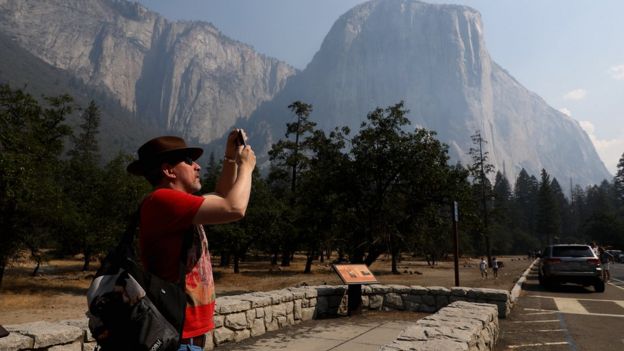
Most of Yosemite's tourist areas have now reopened.
Their closure, mainly due to smoke blowing into the park, damaged the local economy during peak tourist season.
The Ferguson Fire is one of several wildfires that have raged across California in recent weeks.
But cooler weather and calmer winds have helped give fire crews the upper hand, officials said.


"The weather is helping the fires to lay down and they [firefighters] are able to get better containment lines around them," said Cal Fire spokeswoman Lynnette Round.
Park authorities tweeted that the Ferguson Fire was at "100% containment".
"Thank you to all of the firefighters for their hard work and dedication," it added.

The centre of the national park has reopened after being shut for three weeks although lingering smoke meant a few main roads remained closed over the weekend.
Park officials urged visitors to exercise caution, warning that sporadic fires still burned within containment lines.
Elsewhere in the state, the Mendocino Complex fire west of Sacramento is now 76% contained, authorities said. They expect to have full containment of it by 1 September.
The fire - the largest in the state's history - has burned about 335,000 acres.
Further north, the Carr Fire, which has killed at least seven people, is now 83% contained according to officials. The fire has destroyed more than 227,000 acres and destroyed more than 1,000 homes.
A man takes pictures near El Capitan in the Yosemite Valley Tuesday, August 14, 2018

  • Text Widget

  • Pages